
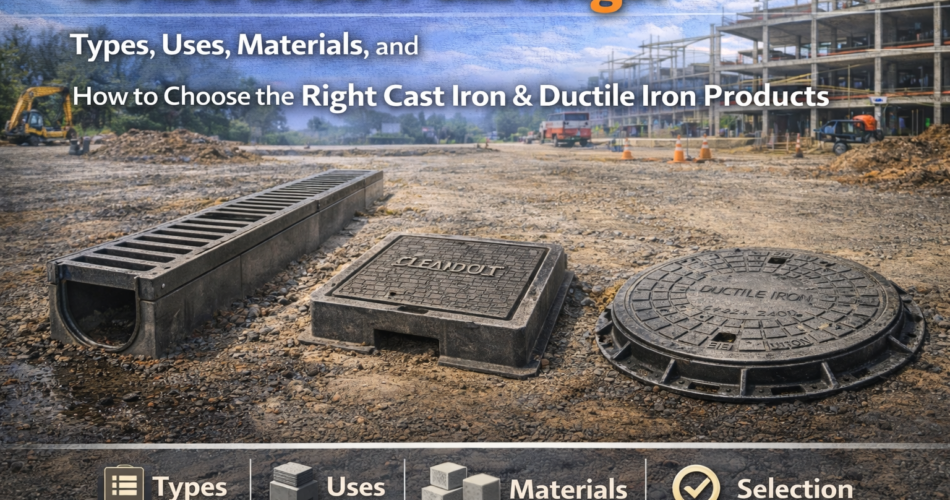
Construction castings are heavy-duty cast components used across roads, drainage, utilities, water supply, building sites, and public infrastructure. These products must handle real-world abuse—vehicle loads, impact, corrosion, and long service cycles—so choosing the right material, load class, and manufacturing quality directly affects safety, maintenance cost, and project life.
Most construction castings are produced in cast iron (grey iron) and ductile iron (SG iron), and are commonly designed to comply with standards like EN124, ASTM, and BS, depending on the market and application.
What Are Construction Castings?
Construction castings are engineered metal cast products installed in or around civil works to provide:
- safe access to underground chambers (manholes, inspection points)
- stormwater intake and drainage control (gully gratings, catch basins)
- protection and access to utilities (valve boxes, surface boxes)
- durable components for public works and industrial civil structures
In short: they’re the “hardware” that keeps infrastructure functional and serviceable.
Common Types of Construction Castings
1) Manhole Covers and Frames
- Solid top manhole covers
- Recessed manhole covers (paver/tile type)
- Heavy duty manhole covers for carriageways and highways
Used for sewer lines, drainage chambers, and utility access.
2) Drainage Gratings and Frames
- Gully gratings
- Catch basin gratings
- Channel gratings / trench drain gratings
- Kerb inlet / combination inlet gratings
Used to collect stormwater and reduce flooding and pipe choking.
3) Utility Access Castings
- Valve boxes
- Surface boxes
- Service boxes
- Meter box covers
Used for water pipelines, hydrants, and underground utility control points.
4) Municipal and Drainage Castings
- inspection covers
- access covers for civic infrastructure
- custom castings for public works requirements
5) Custom Construction Castings (Project-Specific)
Many civil projects require custom dimensions, branding, markings, or special seating/locking—especially for municipal tenders and export supply.
Cast Iron vs Ductile Iron (SG Iron) in Construction Castings
Cast Iron (Grey Iron) Construction Castings
- economical and widely used
- good compressive strength
- suitable for pedestrian/light-to-medium load areas when correctly designed
Ductile Iron (SG Iron) Construction Castings
- higher tensile strength and toughness
- better impact resistance (less brittle failure risk)
- preferred for roads, carriageways, industrial loads, and dynamic traffic zones
- typically the safer long-term choice for heavy-duty applications
If a casting will face vehicle loads, vibration, or shock (roads/industrial yards), SG iron is usually the correct selection.
Load Classes That Matter (EN124)
For construction castings like manhole covers and gratings, load class selection is critical:
- A15: pedestrian areas, footpaths, parks
- B125: light parking areas, driveways
- C250: kerbside and roadside drainage areas
- D400: carriageways, roads, highways (heavy traffic)
- E600: industrial zones (heavy wheel loads)
- F900: airports, ports (extreme loads)
Most failures happen because the wrong class is installed—not because “the casting was weak.”
Key Features of High-Quality Construction Castings
- Correct seating and fitment (prevents rocking and rattling)
- Anti-rattle design (especially important in road zones)
- Coating protection (bitumen / epoxy / powder coating as required)
- Clear markings (municipal name, utility type: WATER/SEWER, load class)
- Locking options (where theft and safety are concerns)
- Consistent metallurgy and QC (repeatability across bulk supply)
How to Choose the Right Construction Castings (Practical Checklist)
Before ordering/specifying:
- Application: drainage / sewer / water utility / telecom / industrial
- Installation zone: footpath / roadside / road / industrial yard
- Traffic load: pedestrian / light vehicles / heavy vehicles
- Required load class: A15/B125/C250/D400/E600/F900
- Material: cast iron vs ductile iron (SG iron)
- Size & clear opening: chamber design and access requirements
- Safety: locking, anti-theft, non-slip surface
- Compliance: EN124 / ASTM / BS as required by tender/export market
If your tender says D400 and you supply B125, you’re setting up a guaranteed failure and liability problem.
Conclusion
Construction castings are essential for safe, long-lasting infrastructure—especially in municipal drainage, utilities, public works, and road construction. The best results come from matching material + load class + design + quality control to the exact installation environment.