
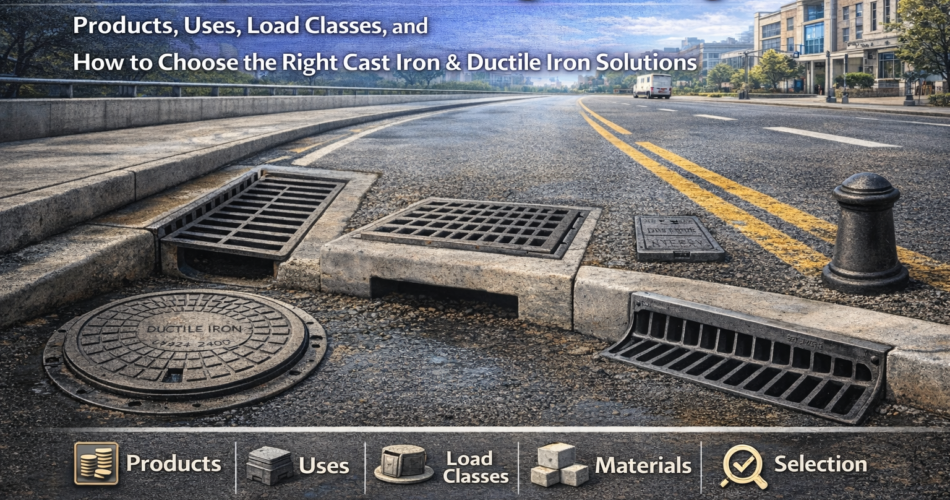
Municipal and drainage castings are essential infrastructure components used in stormwater drainage, sewer networks, water supply utilities, and public works projects. These products sit directly on roads, footpaths, and utility corridors—so they must handle traffic loads, impact, corrosion, and long-term outdoor exposure while maintaining safety and easy maintenance access.
Most municipal and drainage castings are manufactured in cast iron (grey iron) and ductile iron (SG iron) and are commonly supplied to meet international standards such as EN124, ASTM, and BS, depending on project requirements.
What Are Municipal and Drainage Castings?
Municipal and drainage castings include heavy-duty cast products installed at ground level to:
- provide safe access to underground chambers (manholes, inspection points)
- collect rainwater runoff and prevent flooding (gully gratings, catch basins)
- protect and access utility controls (valve boxes, surface boxes)
- support long-term, low-maintenance urban infrastructure
They are used by municipal bodies, contractors, EPC companies, and infrastructure developers.
Common Products in Municipal & Drainage Castings
1) Manhole Covers and Frames
Used for sewer lines, drainage chambers, and inspection points:
- Solid top manhole covers
- Heavy duty manhole covers
- Round manhole covers and frames
- Square/rectangular inspection covers
- Recessed manhole covers (for tiles/pavers, premium zones)
- Riser rings, frames & covers (where required)
2) Drainage Gratings and Frames
Used to collect stormwater quickly and reduce water logging:
- Gully gratings
- Catch basin gratings
- Channel gratings / trench drain gratings
- Kerb inlet gratings
- Combination inlet gratings (top + side entry for high rainfall zones)
3) Utility Access Boxes (Municipal Network Support)
Used in water supply and civic utility networks:
- Valve boxes
- Surface boxes
- Service boxes
- Meter box covers and lids
4) Drainage and Civic Cast Components (Project Specific)
Depending on scope and tender specs:
- frames, covers, and gratings with municipal markings
- anti-theft/lockable covers
- custom sizes and clear openings for project chambers
Cast Iron vs Ductile Iron (SG Iron): Which Is Better for Municipal Use?
Cast Iron (Grey Iron) Municipal Castings
- economical
- good compressive strength
- suitable for pedestrian and controlled-load installations when correctly designed
Ductile Iron (SG Iron) Municipal Castings
- higher tensile strength and impact resistance
- better for traffic zones and dynamic loads
- lower risk of brittle cracking under heavy vehicle movement
- preferred for long-term performance in roads and carriageways
If the casting is installed on roads or near vehicle traffic, ductile iron (SG iron) is usually the correct engineering choice.
EN124 Load Classes (Critical for Roads and Drainage)
Selecting the correct load class prevents breakage, accidents, and repeated replacements:
- A15: pedestrian areas, parks, footpaths
- B125: parking areas, light vehicles, driveways
- C250: kerbside drainage lines and roadside zones
- D400: carriageways, roads, highways (heavy traffic)
- E600: industrial areas
- F900: airports, ports
Most municipal roadside drainage typically requires C250, while road/carriageway installations commonly require D400.
Key Features That Make Municipal Castings Reliable
- Anti-rattle seating and stable fitment (reduces noise and movement)
- Non-slip top surface (important for pedestrian safety)
- Load-tested performance as per class requirement
- Corrosion protection (bitumen / epoxy / powder coating options)
- Clear markings (utility type: WATER/SEWER + load class + branding)
- Locking options where theft or public safety is a concern
- Dimensional accuracy for consistent installation across large projects
How to Choose the Right Municipal & Drainage Castings (Checklist)
Before specifying or purchasing:
- Application: sewer / stormwater / utility access
- Installation zone: footpath / roadside / road / industrial
- Traffic type: pedestrian / light vehicles / heavy vehicles
- Required EN124 class: A15/B125/C250/D400
- Material: cast iron vs ductile iron (SG iron)
- Clear opening & size: match chamber design
- Grating pattern & flow need: rainfall intensity and runoff volume
- Safety: non-slip, locking, anti-rattle
- Maintenance: hinged option for frequent cleaning (where needed)
If you put a low-class cover on a high-traffic road, it will fail sooner or later. That’s a specification mistake, not “bad product.”
Why Municipal Bodies and Contractors Prefer Standard-Compliant Castings
Standard-compliant municipal castings help ensure:
- fewer road failures and accidents
- better drainage performance in heavy rain
- lower maintenance and replacement cost
- smoother project approvals and tender compliance
- consistent supply for large-scale execution
Conclusion
Municipal and drainage castings are the backbone of civic infrastructure—supporting stormwater drainage, sewer networks, and utility access across cities and industrial zones. The right solution depends on load class, material, design, and installation environment. For road and heavy-traffic applications, ductile iron (SG iron) castings with correct EN124 class (C250/D400) are typically the most reliable long-term option.