
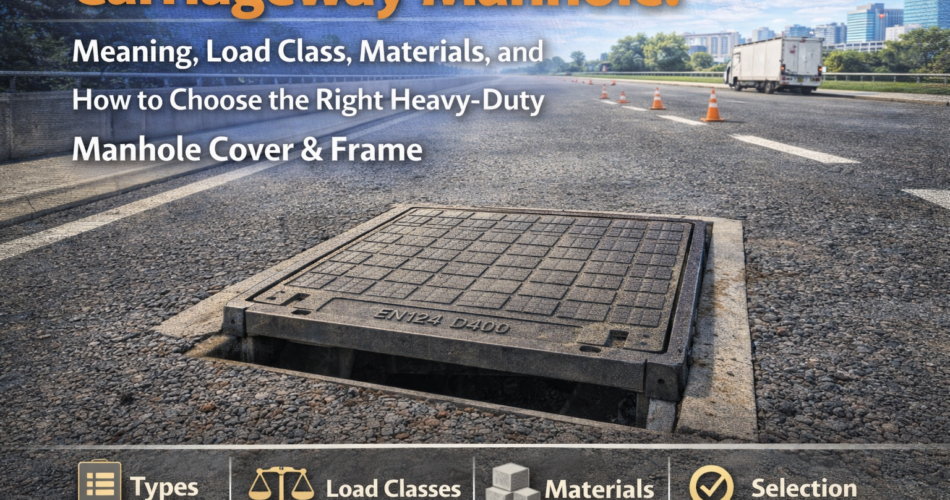
A carriageway manhole is a manhole access point installed directly on roads and carriageways where it must تحمل continuous heavy vehicle loads, vibration, braking impact, and dynamic traffic stress. Because failure on a carriageway can cause accidents and costly repairs, carriageway manholes must be specified with the correct load class, material, seating design, and installation method.
This guide explains what carriageway manholes are, where they are used, what standards matter, and how to select the right carriageway manhole cover and frame.
What Is a Carriageway Manhole?
A carriageway manhole is an access chamber used for:
- sewer lines and inspection chambers
- stormwater drainage networks
- underground utility corridors
- municipal infrastructure maintenance points
What makes it different from normal manholes is the location: it sits on the road carriageway, so the cover must be heavy duty and must stay stable under repeated wheel loads.
Carriageway manholes are often searched as:
- Carriageway manhole cover
- Heavy duty manhole cover
- D400 manhole cover
- Ductile iron manhole cover
- Road manhole cover and frame
- EN124 manhole cover
Where Carriageway Manholes Are Used
- highways and city main roads
- flyovers and service roads
- intersections and turning zones
- industrial roads and truck routes
- bus routes and high axle-load zones
- municipal sewer and stormwater chambers located in the road line
Correct Load Class for Carriageway Manholes (EN124)
For road carriageways, the most common requirement is:
D400 (EN124)
- designed for heavy road traffic and carriageways
- suitable for highways and city roads with trucks and buses
In some extreme zones, specifications can go higher:
- E600: heavy industrial yards
- F900: ports/airports
If someone tries to install B125/C250 on a carriageway, that is a spec error and will eventually lead to failure.
Best Material for Carriageway Manhole Covers
Ductile Iron (SG Iron) — Recommended
For carriageway applications, ductile iron is preferred because it offers:
- higher tensile strength
- better impact resistance
- improved fatigue performance under repeated wheel loads
- lower risk of brittle cracking compared to grey iron
Cast Iron (Grey Iron) — Use Carefully
Cast iron can be used for some road applications only when:
- design + section thickness supports D400 requirements
- quality control and testing are strong
But in practice, most long-life road projects lean toward ductile iron for reliability.
Key Design Features for Carriageway Manholes (What Actually Prevents Failure)
1) Anti-Rattle / Stable Seating
A good seat prevents rocking and noise, and reduces stress concentration.
2) Proper Frame Anchorage
The frame must be seated on a proper RCC bed and anchored correctly to avoid settlement.
3) Non-Slip Surface Pattern
Improves vehicle grip, especially during rain.
4) Locking Mechanism (Optional)
Used where theft, safety, or unauthorized access is a concern.
5) Coating Protection
Bitumen/epoxy/powder coating can improve corrosion resistance and appearance.
6) Correct Clear Opening & Thickness
The cover must match the chamber size and load design—“heavier” alone is not proof of correct class.
Common Problems in Carriageway Manholes (And the Real Causes)
Problem: Cover breaks or cracks
Cause: wrong load class, wrong material, poor casting quality, or poor bedding.
Problem: Rattling noise when vehicles pass
Cause: poor seating, uneven installation, frame settlement.
Problem: Cover rocking / frame shifting
Cause: improper RCC bedding, incorrect frame fixing, bad leveling.
Problem: Water ingress / chamber flooding
Cause: poor sealing, damaged seating, incorrect slope around frame.
Most “product issues” are actually installation + specification issues.
How to Choose the Right Carriageway Manhole Cover & Frame (Checklist)
Before ordering:
- Confirm location: carriageway / road / industrial road
- Select load class: usually EN124 D400
- Choose material: preferably ductile iron (SG iron)
- Decide shape: round (preferred for roads) or square as per chamber
- Check design features: anti-rattle, non-slip, optional locking
- Confirm size: clear opening + overall frame dimension
- Ask for testing/QC: load test capability where required
- Plan proper installation: RCC bed, leveling, anchoring, correct finish level
Round vs Square for Carriageway Manholes
Round Covers (Preferred for Roads)
- better load distribution
- less rocking risk
- safer because round covers cannot fall into the opening
Square/rectangular covers are used when the chamber design requires it, but round is usually the best engineering choice for carriageways.
Conclusion
A carriageway manhole is a safety-critical road component. For reliable performance, specify heavy duty manhole covers and frames with the correct EN124 load class (typically D400) and choose ductile iron (SG iron) for durability and impact resistance. Combine that with correct seating and installation, and the manhole will perform reliably for years.