
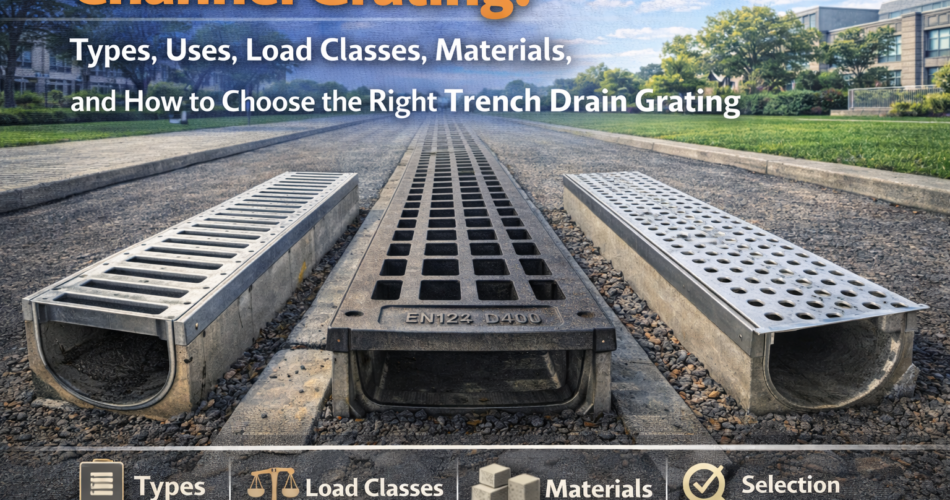
A channel grating (also called a trench drain grating or drainage channel grating) is a heavy-duty grating installed over a linear drainage channel to collect and carry stormwater (or process water) safely away from roads, pavements, industrial floors, parking areas, and public spaces.
Channel gratings are essential where water flow is spread across a wide area and you need continuous drainage, not just point drainage like a catch basin.
What Is a Channel Grating?
A channel grating is the top load-bearing cover that sits on a drainage channel/trench. Water enters through the grating slots into the channel and flows to the outlet point.
Channel gratings are commonly searched as:
- Trench drain grating
- Linear drain grating
- Drain channel grating
- Stormwater channel grating
- Cast iron channel grating
- Ductile iron (SG iron) channel grating
- EN124 channel grating
Where Channel Gratings Are Used
Municipal & Road Infrastructure
- road edges and service roads
- bus bays and depots
- junctions prone to water logging
- flyovers/underpasses (with correct design)
Commercial Projects
- parking lots and basements
- malls and commercial complexes
- hospitals, campuses, walkways
Industrial Applications
- factory floors and yards
- loading bays and docks
- workshops and utility corridors
- areas needing continuous drainage for wash-down
Residential & Landscaping
- driveways and apartment entrances
- paved walkways and landscaped zones (light-duty class)
Types of Channel Gratings
1) Slotted Channel Grating
- long slots for continuous water entry
- good for high-flow areas
- must be designed for safety (slot width)
2) Mesh / Perforated Channel Grating
- better debris control
- often used where smaller waste is an issue
3) Heel-Proof Channel Grating (Pedestrian Safety)
- designed to prevent heels from getting stuck
- common in plazas, footpaths, commercial walkways
4) Heavy Duty Channel Grating
- thicker section and stronger seating
- suitable for vehicle traffic zones (with correct EN124 class)
5) Hinged / Lockable Channel Grating (Optional)
- useful where frequent cleaning is required
- adds safety and anti-theft control in public areas
Materials: Cast Iron vs Ductile Iron (SG Iron) Channel Gratings
Cast Iron Channel Grating
- economical option
- suitable for pedestrian/light-load areas when properly specified
Ductile Iron (SG Iron) Channel Grating
- higher tensile strength and impact resistance
- preferred for parking areas, roads, and industrial yards
- lower risk of brittle failure under dynamic vehicle loads
If the trench drain is in a traffic zone, ductile iron channel gratings are the safer long-term choice.
EN124 Load Classes for Channel Gratings (Selection Guide)
Choose load class based on installation area:
- A15: pedestrian areas, parks, footpaths
- B125: driveways, parking areas (light vehicles)
- C250: kerbside areas and roadside drainage lines
- D400: roads, carriageways, highways (heavy traffic)
- E600: industrial zones (heavy wheel loads)
- F900: airports, ports (extreme loads)
For most parking and commercial areas: B125
For roadside drainage: C250
For roads: D400
If you install a lower class in a higher load zone, failure is guaranteed over time.
Key Design Features That Matter in Channel Gratings
- Strong frame seating / channel edge support (prevents rocking)
- Anti-rattle design (important in traffic zones)
- Non-slip top surface (safer during rain)
- Proper slot pattern (safe for pedestrians/cycles + good intake)
- Corrosion protection (bitumen/epoxy/powder coating options)
- Easy maintenance access (hinged options for cleaning)
How to Choose the Right Channel Grating (Practical Checklist)
Before ordering/specifying:
- Location: pedestrian / parking / roadside / road / industrial
- Traffic load: pedestrian vs vehicles vs heavy-duty
- Load class: A15/B125/C250/D400/E600/F900
- Channel width & length: must match civil design
- Hydraulic requirement: expected rainfall/runoff or process flow
- Safety requirement: heel-proof slots for public zones
- Maintenance: hinged/lockable if cleaning is frequent
- Material: ductile iron for dynamic loads, cast iron for light-duty zones
Common Problems (And the Real Causes)
Water still accumulates
Cause: insufficient channel size, wrong slope, or not enough outlets
Fix: verify hydraulic design and slope, add outlets, increase channel capacity.
Grating breaks or bends
Cause: wrong load class/material or poor seating support
Fix: upgrade to correct class (C250/D400), use ductile iron, improve bedding/support.
Rattling noise
Cause: poor alignment and seating
Fix: anti-rattle seating + correct installation with proper level finishing.
Conclusion
Channel gratings provide continuous, reliable drainage for municipal, commercial, and industrial projects. The correct selection depends on load class (EN124), material (cast iron vs ductile iron), slot design, and proper installation. For traffic and industrial zones, ductile iron channel gratings with correct class (C250/D400/E600) are generally the most reliable.