
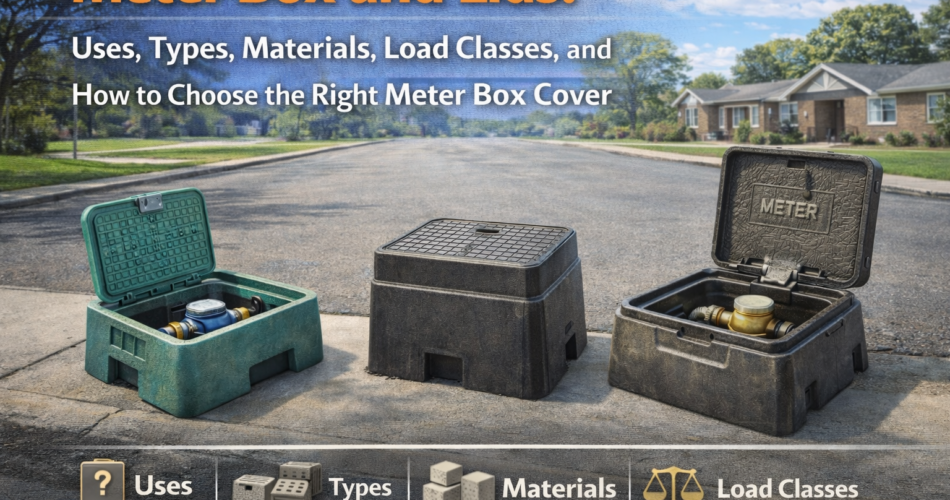
Meter boxes and lids are protective enclosures used to secure and provide easy access to water meters (and sometimes gas/electrical metering points) installed underground or at ground level. The meter box protects the meter and valves from impact, weather, tampering, and accidental damage, while the lid/cover ensures safe access for reading, maintenance, and replacement.
For municipal and utility projects, meter box lids must be selected based on location (footpath/roadside/road), load class, and material, not just size.
What Is a Meter Box?
A meter box is a chamber/enclosure (RCC/brick/precaster/polymer, depending on the project) that houses:
- water meter body
- inlet/outlet connections
- isolation valve / stop cock (in many installations)
- sometimes small strainers or fittings
The meter box lid/cover sits at ground level to allow:
- meter reading
- servicing and replacement
- valve operation
Also searched as:
- water meter box cover
- meter box lid
- water meter chamber cover
- meter box cover and frame
- utility meter cover
Where Meter Boxes Are Used
Municipal & Utility Networks
- domestic water connections
- apartment and housing projects
- commercial water meter installations
- zone metering / bulk metering chambers (with larger covers)
Industrial & Campus Water Supply
- industrial water distribution metering
- institutional campuses and factories
Roadside / Footpath Installations
- footpaths and walkways (most common)
- boundary walls and entrance areas
- sometimes parking/driveway zones (requires higher class)
Types of Meter Boxes and Lids
1) Round Meter Box Lid
- common in domestic water meter points
- stable seating and easy alignment
2) Square / Rectangular Meter Box Lid
- widely used in housing projects
- better suited for chamber layouts with valves and fittings
3) Flush Type / Recessed Meter Box Lid
- used in paved areas with tiles/pavers
- gives clean finish and reduces trip hazard
4) Lockable Meter Box Lid (Anti-Tamper)
- prevents theft and unauthorized operation
- useful in public-access areas
5) Heavy Duty Meter Box Lid
- used where vehicles may pass (parking/driveway/road-edge)
- requires correct EN124 load class
Materials: Cast Iron vs Ductile Iron (SG Iron) Meter Box Lids
Cast Iron Meter Box Lids
- economical option
- suitable for pedestrian/light-load areas when properly specified
Ductile Iron (SG Iron) Meter Box Lids
- higher strength and impact resistance
- better for roadside/parking/driveway applications
- lower risk of cracking under dynamic loads
If vehicles can pass over it even occasionally, ductile iron is the safer long-term choice.
Load Classes (EN124) for Meter Box Covers
Select the cover class based on installation zone:
- A15: pedestrian areas, footpaths, parks
- B125: driveways, light parking areas
- C250: kerbside/roadside zones
- D400: roads and carriageways (heavy traffic)
Most domestic meter boxes on footpaths use A15, while driveway/parking zones often need B125.
Installing an A15 cover where cars pass is a predictable failure and safety issue.
Key Features of Good Meter Box Lids
- Proper seating & stable fit (prevents rocking and rattling)
- Non-slip surface (safer during rain)
- Clear marking (WATER / METER as required)
- Corrosion protection (bitumen/epoxy/powder coating options)
- Locking option (anti-theft / anti-tamper)
- Easy opening design (lifting key slot/handle type)
How to Choose the Right Meter Box and Lid (Checklist)
Before ordering/specifying:
- Meter size & fittings layout (space needed inside chamber)
- Location: footpath / boundary / driveway / roadside
- Traffic load: pedestrian vs vehicle
- Load class: A15/B125/C250/D400
- Shape & size: round/square + clear opening
- Security requirement: lockable or standard
- Finish requirement: flush/recessed for paver areas
- Material: cast iron vs ductile iron (SG iron)
Conclusion
Meter boxes and lids protect critical water metering infrastructure and keep reading and maintenance simple. The right selection depends on location, load class, material, and safety requirements. For long life and fewer failures, always match the lid to the correct EN124 class and choose ductile iron for any area exposed to vehicle movement.