
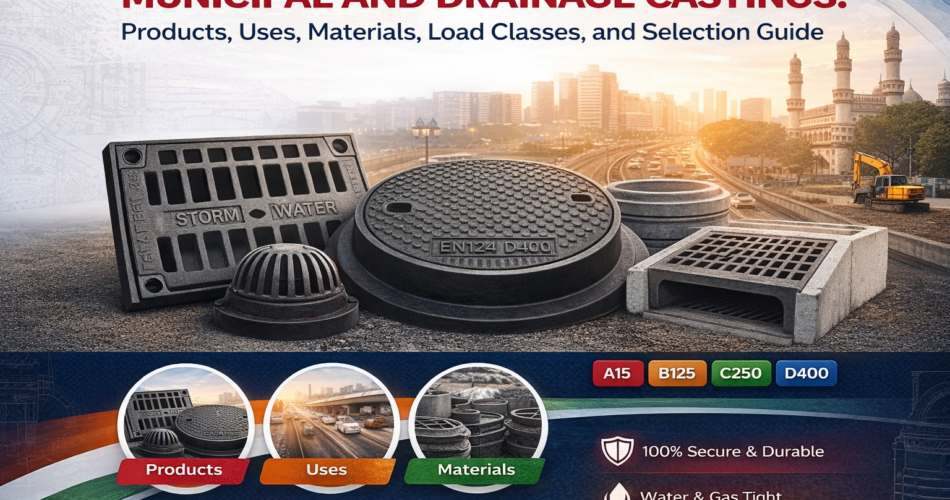
Municipal and drainage castings are essential infrastructure components used in stormwater drainage, sewer networks, and utility corridors to provide safe access, efficient water intake, and long-term durability in public environments. These castings are installed on footpaths, kerbside zones, parking areas, and roads, so they must withstand traffic loads, impact, vibration, corrosion, and continuous outdoor exposure. Correct selection of material, load class, seating design, and installation quality directly determines safety, service life, and maintenance cost.
What Are Municipal and Drainage Castings?
Municipal and drainage castings are engineered cast products manufactured in cast iron (grey iron) and ductile iron (SG iron) for civic infrastructure applications. They include access covers, manhole covers and frames, drainage gratings and frames, and utility access boxes used by municipalities, contractors, and infrastructure developers. Depending on project requirements, these products may be specified to meet standards such as EN124 and may also align with ASTM or BS specifications for certain markets and tenders.
Where Municipal and Drainage Castings Are Used
Municipal and drainage castings are used in city stormwater systems, roadside drainage corridors, sewer inspection chambers, public works and civic utility networks, highways and carriageways, parking areas and commercial complexes, industrial utility corridors, campuses and housing developments, and any location requiring durable access and drainage components at ground level.
Common Products in Municipal and Drainage Castings
Manhole covers and frames are used for sewer and drainage chambers and include solid top manhole covers, heavy duty manhole covers, round manhole covers and frames, square and rectangular inspection covers, and recessed manhole covers for tiled or paver areas. Drainage gratings and frames are used for stormwater intake and include gully gratings, catch basin gratings, channel gratings, trench drain gratings, kerb inlet gratings, and combination inlet systems. Utility access products used within municipal networks include valve boxes, surface boxes, service boxes, meter box lids, and other inspection covers and access frames required for water and utility control points. Many municipal projects also require custom sizes, municipal markings, anti-theft arrangements, and locking features based on tender specifications.
Cast Iron vs Ductile Iron (SG Iron) for Municipal Applications
Cast iron municipal castings are commonly used for pedestrian and controlled-load installations where compressive strength and cost efficiency are important and impact loads are moderate. Ductile iron (SG iron) municipal castings provide higher tensile strength, better impact resistance, and improved fatigue performance and are generally preferred for kerbside, roadside, and traffic-exposed installations. In road and carriageway applications, ductile iron is typically the safer long-term choice due to reduced brittle cracking risk under dynamic vehicle loads.
EN124 Load Classes for Municipal and Drainage Castings (Critical Specification)
Load class selection is essential for safety and performance. A15 is used for pedestrian areas, parks, and footpaths. B125 is used for driveways and light parking areas. C250 is commonly used for kerbside and roadside drainage lines where wheel loads may approach the edge. D400 is used for roads, carriageways, and heavy traffic areas. E600 is used for industrial heavy-load zones, and F900 is used for extreme-duty zones such as ports and airports. Installing a lower class casting in a higher load zone is a specification error and the most common cause of cracking, rocking, rattling, and premature failure.
Key Features That Improve Performance and Safety
Reliable municipal and drainage castings depend on stable seating and accurate fitment to prevent rocking and rattling under traffic. Non-slip top patterns improve pedestrian and vehicle safety in wet conditions. Anti-rattle seating reduces noise and minimizes stress concentration at contact points. Locking and anti-theft options may be required in public zones to prevent tampering and unauthorized access. Corrosion protection coatings such as bitumen, epoxy, or powder coating can be specified based on environmental exposure. Clear markings for utility type and load class support correct identification and maintenance operations.
Common Problems and Their Real Causes
Rattling and rocking typically result from poor seating design, incorrect installation level, frame settlement, or improper RCC bedding and anchoring. Cracking and breakage most often occur due to wrong load class selection, unsuitable material choice for traffic exposure, or poor installation and finishing. Water stagnation around covers and gratings commonly results from incorrect slope and surface level alignment during finishing. Drainage underperformance often comes from insufficient inlet capacity, poor spacing, or mismatch between grating design and hydraulic requirement.
How to Choose the Right Municipal and Drainage Casting
Start by confirming the application and installation environment (footpath, parking, kerbside, road, carriageway, industrial). Select the correct EN124 load class based on traffic exposure (A15, B125, C250, D400, E600, F900). Choose cast iron for controlled-load zones or ductile iron (SG iron) for traffic and impact-exposed installations. Finalize size and clear opening to match chamber design and access requirements. Specify product type (manhole cover, inspection cover, gully grating, catch basin grating, channel grating, valve box, surface box) and required features such as anti-rattle seating, non-slip surface, optional locking, and corrosion protection coating. Ensure proper installation with RCC bedding, accurate leveling, stable frame anchoring, and correct finished surface alignment to achieve long service life.
Municipal and drainage castings form the backbone of safe, maintainable urban infrastructure. When specified with the correct load class, manufactured with consistent metallurgy and fitment, and installed properly, these castings deliver reliable performance, reduced maintenance, and long-term value across stormwater, sewer, and civic utility networks.