
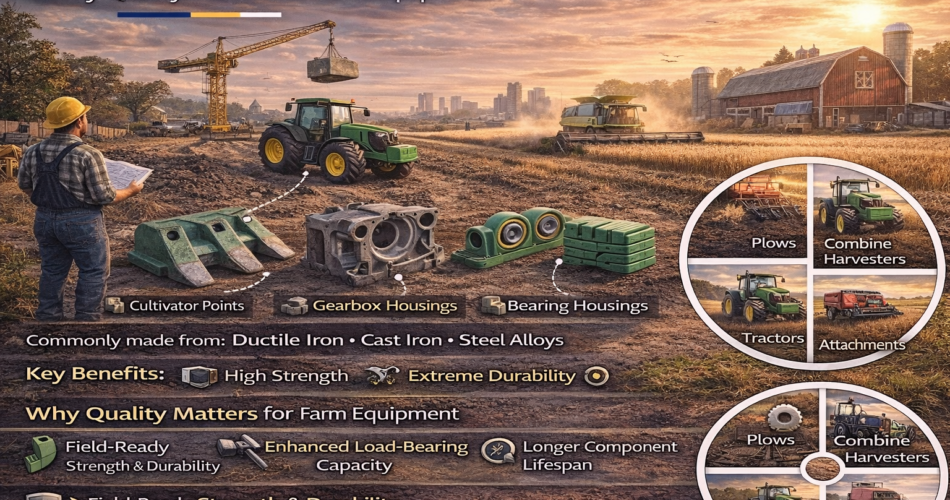
Agricultural castings are essential components used in a wide range of farm machinery and rural infrastructure. From tractors and tillers to irrigation systems and implements, cast iron and ductile iron castings provide the strength, durability, and wear resistance needed to operate in harsh field conditions—mud, dust, water exposure, impact loads, and continuous vibration.
If agricultural castings fail, the damage isn’t just a part replacement—it’s downtime during critical farming cycles. That’s why quality and material selection matter more than people admit.
What Are Agricultural Castings?
Agricultural castings are metal cast components manufactured primarily from grey cast iron or ductile iron (SG iron) and used in agricultural equipment and related applications. These parts are designed to handle:
- heavy mechanical loads
- abrasive wear from soil and sand
- impact and shock during field operations
- long exposure to outdoor conditions
Common Types of Agricultural Castings
Agricultural casting requirements vary by equipment type, but common cast parts include:
- Tractor and implement housings
- Gearbox bodies and covers
- Counterweights and ballast blocks
- Pulley and sheave components
- Bearing housings and brackets
- Mounting arms and structural supports
- Cultivator, rotavator, and tiller parts (selected components)
- Irrigation and pipeline cast components (where required)
Exact designs are often customized depending on machine model and load requirements.
Where Agricultural Castings Are Used
Agricultural castings are used across:
- Farm machinery manufacturers (OEMs)
- Aftermarket spares
- Irrigation and rural water supply projects
- Agro-industrial equipment
- Poultry, dairy, and feed processing machinery (selected cast parts)
They support both mobile equipment (tractors/implements) and fixed infrastructure (water and utility components).
Key Benefits of Agricultural Castings
Well-made agricultural castings deliver:
- High durability: Designed to survive vibration, shock, and load cycles.
- Wear resistance: Especially important in soil-contact and abrasive environments.
- Cost-effective strength: Casting allows complex shapes at economical cost.
- Reliable performance: Stable dimensions and controlled metallurgy reduce failures.
- Long service life: Better cast quality = fewer breakdowns during peak season.
Grey Iron vs Ductile Iron (SG Iron) for Agricultural Castings
Choosing the correct material is the difference between “works fine” and “keeps cracking.”
Grey Cast Iron Agricultural Castings
- Good machinability and vibration damping
- Suitable for housings and many standard parts
- Cost-effective when loads are moderate
Ductile Iron (SG Iron) Agricultural Castings
- Higher tensile strength and impact resistance
- Better for parts exposed to shock loads or higher stresses
- Lower risk of brittle cracking
If the component sees frequent impact or heavy dynamic loading, ductile iron is typically the safer choice.
Why Quality Control Matters (Real-World View)
Agricultural castings often fail due to:
- poor metallurgy or incorrect composition
- internal casting defects (porosity, shrinkage)
- weak section design or inconsistent wall thickness
- poor machining accuracy and misalignment
- inadequate finishing and corrosion protection
In agricultural use, a small defect becomes a big failure fast because loads are repetitive and conditions are harsh.
What to Check Before Buying Agricultural Castings
If you are sourcing cast parts for farm equipment, evaluate these:
- Material grade and consistency: Grey iron or SG iron as per design need.
- Dimensional accuracy: Critical for fitment, alignment, and bearing life.
- Mechanical testing: Hardness and load-related tests where applicable.
- Surface finish and machining quality: Poor machining causes vibration and early wear.
- Coating/paint protection: Helps reduce rusting during outdoor storage and operation.
- Repeatability: The supplier should deliver consistent batches, not “one good lot.”
Cheap castings are rarely cheap once replacements and downtime are counted.
Conclusion
Agricultural castings are the backbone of durable farm machinery and rural infrastructure components. Choosing the right material (grey iron or ductile iron), ensuring strict quality control, and sourcing from a reliable manufacturer improves equipment life, reduces breakdowns, and saves cost over time—especially during peak agricultural seasons.
If you need agricultural castings that perform under real field conditions, prioritize strength, consistency, and proper manufacturing standards—not just price on paper.