
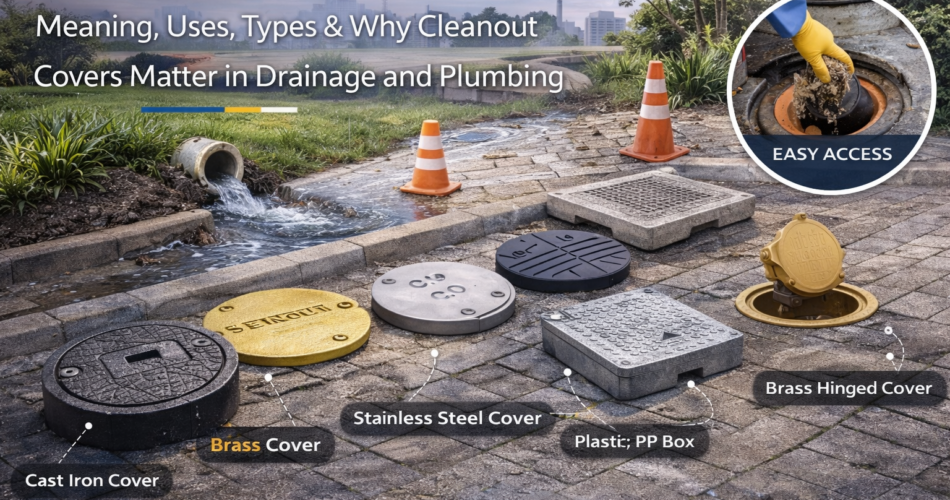
Cleanouts are access points installed in drainage and sewer pipelines to allow inspection, rodding, and blockage removal without breaking floors, roads, or walls. In municipal drainage, commercial plumbing, industrial utility lines, and residential projects, cleanouts are small components—but they prevent big problems: costly repairs, flooding, and long downtime when choking happens.
If a drainage line has no cleanout access, you’re not designing a system—you’re designing future demolition.
What Are Cleanouts?
A cleanout is a pipe access opening connected to a drainage line that enables maintenance tools (rods, jetting hoses, cameras) to enter the pipeline. A standard cleanout assembly typically includes:
- Cleanout body / access point
- Threaded plug or cover
- Frame and cover (for floor/ground level installations, where required)
Cleanouts are located at strategic points so blockages can be cleared quickly.
Where Cleanouts Are Used
Cleanouts are used in:
- Residential and commercial plumbing systems
- Basement drainage lines and parking area drains
- Industrial drainage and utility networks
- Municipal sewer and stormwater lines (selected access points)
- Kitchen, wash area, and high-grease discharge lines
- Long pipeline runs and change-of-direction points
Anywhere choking risk exists—cleanouts are necessary.
Why Cleanouts Are Important (Practical Benefits)
Cleanouts offer clear operational advantages:
- Fast blockage removal: No need for excavation or breaking surfaces.
- Lower maintenance cost: Routine cleaning becomes easier and cheaper.
- Reduced downtime: Critical for commercial buildings and industrial sites.
- Prevents overflow damage: Early access helps stop backflow and flooding.
- Improves system life: Regular cleaning reduces long-term pipeline stress and buildup.
Types of Cleanouts
Cleanouts are selected based on installation location and usage:
- Floor Cleanout
- Used in basements, parking areas, utility rooms
- Typically includes a cover flush with floor level
- Wall Cleanout
- Installed in vertical stacks or service shafts
- Easy access without disturbing flooring
- Outdoor / Yard Cleanout
- Installed in open areas and near property boundaries
- Needs durable cover to handle outdoor exposure
- Road/Traffic Area Cleanout (Heavy Duty)
- Installed where vehicles may pass
- Requires strong frame and cover to prevent breakage
- Lockable Cleanout Cover (Optional)
- Helps prevent tampering or theft in public zones
Cleanout Covers: Cast Iron vs Ductile Iron (SG Iron)
For cleanouts installed at ground or floor level, cover strength matters.
Cast Iron Cleanout Covers
- Cost-effective for many standard applications
- Suitable for moderate load areas when quality is controlled
Ductile Iron (SG Iron) Cleanout Covers
- Higher impact resistance and strength
- Better for heavy traffic, industrial, and high-load zones
- Lower risk of cracking under shock loads
If the cleanout is in a driveway, parking lot, or industrial yard, ductile iron is typically the safer choice.
How to Choose the Right Cleanout (Checklist)
Before selecting cleanouts and covers, check:
- Location and load: Foot traffic vs vehicle movement determines duty type.
- Size compatibility: Must match pipeline diameter and cleaning tool access.
- Flush finish: Cover should sit level to avoid trip hazards and damage.
- Sealing and fitment: Good seating reduces smell, water ingress, and rattling.
- Corrosion resistance: Coating/finish matters for wet environments.
- Ease of opening: Maintenance teams should be able to open it without damage.
A cleanout that can’t be opened easily is not an access point—it’s a decorative problem.
Common Problems Caused by Wrong Cleanout Selection
- Cover breaking or cracking: Wrong duty class or poor casting quality
- Bad smell leakage: Poor sealing and improper seating
- Water ingress and rusting: Weak finish/coating and poor drainage around cover
- Cover stuck/jammed: Poor machining, corrosion, or incorrect installation
These issues are preventable with correct specification and quality.
Maintenance Tip
Cleanouts are only useful if they’re accessible. Don’t bury them under tiles, permanent fixtures, or asphalt without a proper frame and cover arrangement. Marking cleanout locations in as-built drawings saves time during maintenance and emergencies.
Conclusion
Cleanouts are essential for efficient drainage maintenance—helping clear blockages, reduce repair costs, and prevent damage from overflow. Whether in residential buildings, commercial complexes, industrial sites, or selected municipal applications, choosing the right cleanout type and cover grade ensures long-term reliability.
For cleanouts that perform in real conditions, specify based on location load, ensure proper cover fitment, and choose materials built for durability—not shortcuts that create future repair headaches.