
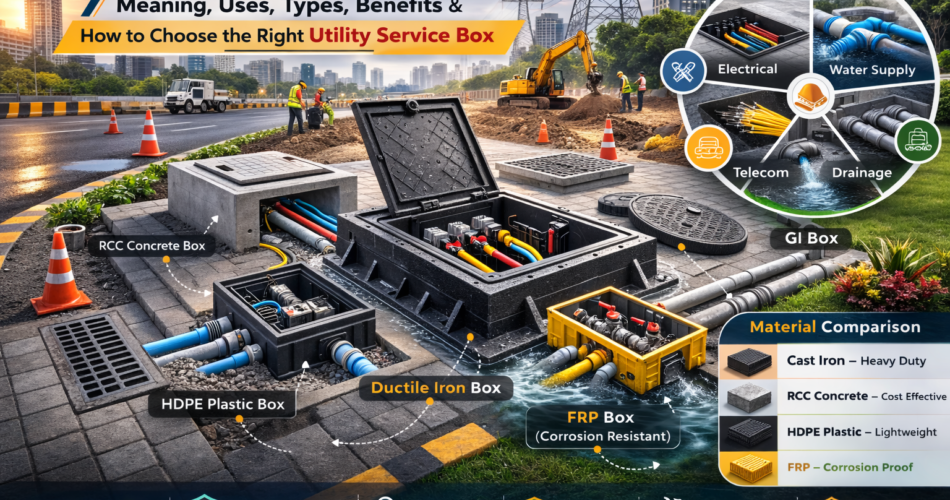
A service box is a protective access enclosure installed at ground level to provide safe and convenient access to underground utility service points. It is commonly used for water supply service connections, valve operating points, pipeline controls, and utility access points in municipal, industrial, and commercial infrastructure.
Service boxes are small components, but they directly impact maintenance speed, public safety, and long-term reliability. If you skip them—or choose weak ones—you end up with buried access points, damaged valves, and repeated road or floor cutting.
What Is a Service Box?
A service box is an access unit that typically includes:
- Frame/body
- Top lid/cover
- Access opening (for key operation or inspection)
- Optional extension arrangement (depending on depth and final ground level)
Its primary purpose is to protect underground service points from:
- soil and debris entry
- surface impact and traffic loads
- water ingress and corrosion buildup
- tampering (in lockable variants)
Where Service Boxes Are Used
Service boxes are widely used in:
- Municipal water supply networks
- Residential service connections and townships
- Commercial buildings and complexes
- Industrial plants and utility corridors
- Fire line service access points
- Irrigation and agricultural distribution systems
- Public infrastructure projects and road utilities
Anywhere a service valve or utility access point must remain reachable from the surface, a service box is essential.
Key Benefits of Using a Service Box
A properly selected service box provides:
- Quick access for operation and maintenance: No excavation required for routine work.
- Better protection for valves and fittings: Reduces damage to underground components.
- Cleaner and safer sites: Prevents open pits and makeshift covers.
- Reduced maintenance cost: Saves time during shutdowns and emergency repairs.
- Longer utility life: Protects key components from debris and corrosion exposure.
- Improved surface durability: Heavy-duty models handle traffic without cracking.
Types of Service Boxes
Service boxes are selected based on installation area and load conditions:
- Round Service Box
- Common in municipal distribution lines
- Easy alignment and installation
- Square/Rectangular Service Box
- Preferred where access opening needs to be wider
- Often used in commercial/industrial layouts
- Light Duty Service Box
- For footpaths, gardens, campuses, low-load areas
- Medium / Heavy Duty Service Box
- For driveways, internal roads, and traffic zones
- Designed for vehicular movement impact
- Lockable Service Box (Optional)
- Helps prevent tampering and unauthorized operation
- Useful in public zones and critical service points
- Adjustable / Telescopic Service Box (Optional)
- Supports level adjustments during resurfacing or paving changes
Cast Iron vs Ductile Iron (SG Iron) Service Boxes
Material selection affects strength and reliability:
Cast Iron Service Box
- Cost-effective for many standard service applications
- Suitable for moderate load zones when quality-controlled
Ductile Iron (SG Iron) Service Box
- Higher tensile strength and impact resistance
- Better for traffic zones and long-life utility networks
- Lower risk of cracking under shock loads
For any installation near roads or vehicle movement areas, ductile iron is typically the safer option.
How to Choose the Right Service Box (Practical Checklist)
Before selecting a service box, verify:
- Load condition at installation point: Footpath vs driveway vs roadway.
- Depth and height requirement: Ensure proper access without burying the service point.
- Cover seating and stability: Prevents rattling, rocking, and early failure.
- Anti-slip surface: Important for wet outdoor conditions.
- Corrosion protection: Coating/finish matters for permanent outdoor exposure.
- Security requirements: Locking where unauthorized access is possible.
- Ease of operation: The opening must support proper valve key access.
Choosing the wrong duty class is the most common failure reason—and it’s 100% avoidable.
Common Problems Caused by Poor Service Boxes
- Cracked lid: Under-rated load capacity
- Rattling and movement: Poor seating and inaccurate dimensions
- Buried service point: Wrong height or no extension arrangement
- Rusting and jammed lid: Poor coating and water stagnation
These aren’t “site issues.” These are selection and specification issues.
Conclusion
Service boxes protect underground service points, improve access, and reduce maintenance costs across municipal, commercial, and industrial utility systems. Selecting the correct design, duty class, and material ensures safe operation and long-term performance.
For reliable infrastructure, always choose service boxes based on real load conditions and access requirements—not just price—because fixing buried or damaged service points after road completion costs far more than doing it right from the start.