
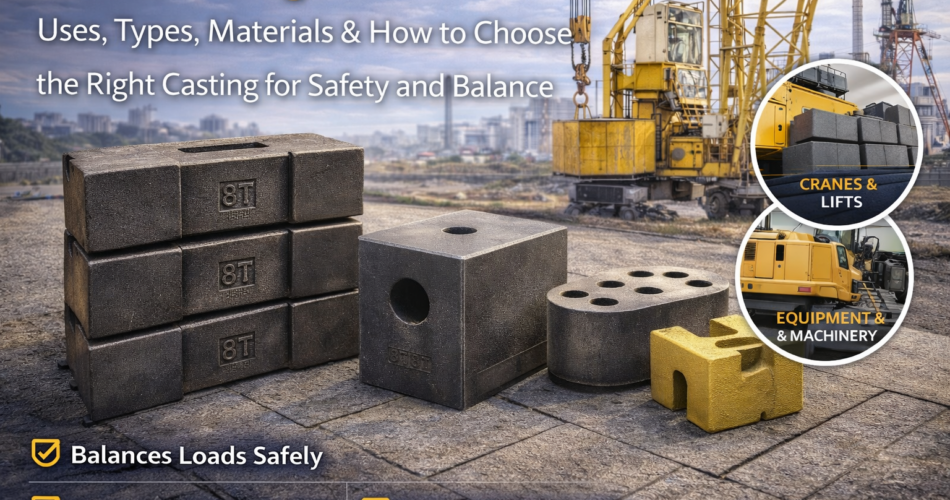
Counter weights are engineered components used to balance loads, improve stability, and control motion in machines, structures, and lifting systems. In practical terms, a counter weight reduces strain on motors and mechanisms, improves operational safety, and prevents tipping or uncontrolled movement. You’ll find counter weights across construction equipment, elevators, cranes, material handling systems, industrial machinery, and many custom engineering applications.
The mistake most buyers make is treating counter weights as “just heavy metal.” Wrong material, poor casting quality, or inaccurate weight leads to vibration, imbalance, premature wear, and safety risks.
What Are Counter Weights?
A counter weight is a mass specifically designed and positioned to counterbalance another mass. Its purpose is to achieve equilibrium or controlled movement. Counter weights are commonly manufactured as cast iron or ductile iron castings, because casting allows:
- precise weight targets
- complex shapes and mounting features
- consistent repeatability for production
- durable performance in harsh environments
Where Counter Weights Are Used
Counter weights are widely used in:
- Elevators and lifts (balancing car movement)
- Cranes and hoists (load stability and anti-tipping)
- Construction equipment (excavators, loaders, forklifts, compactors)
- Material handling systems (industrial mechanisms and balancing arms)
- Industrial machines (rotating assemblies and vibration control)
- Custom engineering setups where controlled counterbalance is required
Key Benefits of Counter Weights
A correctly designed counter weight provides:
- Improved safety and stability in moving equipment
- Lower energy consumption by reducing effort needed to lift or move loads
- Reduced vibration and smoother operation
- Less wear on bearings, shafts, gears, and motors
- Better load control and equipment lifespan
Types of Counter Weights
Counter weights vary based on application and mounting method:
- Machine Counter Weights
- Used in industrial machines, rotating systems, press mechanisms, etc.
- Equipment Counter Weights
- Used in heavy equipment like excavators, loaders, cranes, forklifts.
- Stackable / Modular Counter Weights
- Designed in multiple pieces to adjust total weight as required.
- Custom-Shaped Counter Weights
- Made to fit specific machine geometry with pockets, ribs, holes, and mounting points.
Cast Iron vs Ductile Iron (SG Iron) Counter Weights
Material selection depends on stress, impact, and mounting design.
Cast Iron Counter Weights
- Cost-effective and widely used
- Suitable when loads are mainly static and impact is limited
- Good casting feasibility for complex shapes
Ductile Iron (SG Iron) Counter Weights
- Higher tensile strength and better impact resistance
- More suitable if the counter weight is subjected to shock, vibration, or mechanical stress
- Better toughness reduces risk of cracking in demanding environments
If the counter weight is part of heavy-duty equipment with repeated impact/vibration, ductile iron is often the safer technical choice.
What to Check Before Selecting Counter Weights (Practical Checklist)
Before finalizing counter weights, verify:
- Target weight accuracy: The finished weight must match the design requirement within acceptable tolerance.
- Dimensional accuracy: Mounting holes, faces, and seating areas must align properly.
- Center of gravity (CG): Weight distribution matters as much as total weight in stability-critical systems.
- Mounting design: Check inserts, holes, slots, lifting points, and fastening features.
- Surface protection: Coating/painting helps prevent rust during outdoor use or storage.
- Repeatability: If you’re ordering multiple units, consistency across batches is non-negotiable.
Common Problems from Low-Quality Counter Weights
- Imbalance and vibration due to inaccurate weight or uneven distribution
- Cracking at mounting points from poor metallurgy or weak design sections
- Poor fitment because of dimensional deviation
- Rust and seizure in assemblies due to weak finishing/coating
- Early wear in connected parts (bearings, shafts, brackets) because balance is off
These problems usually cost more than the counter weight itself.
Conclusion
Counter weights are critical safety and performance components used to balance loads and stabilize machinery. Choosing the right material (cast iron or ductile iron), ensuring accurate weight and CG control, and demanding consistent casting quality is the difference between smooth long-term operation and repeated breakdowns.
If your application is load-critical or safety-critical, don’t buy counter weights based on price per kg—buy based on engineering accuracy, durability, and consistent manufacturing quality.