
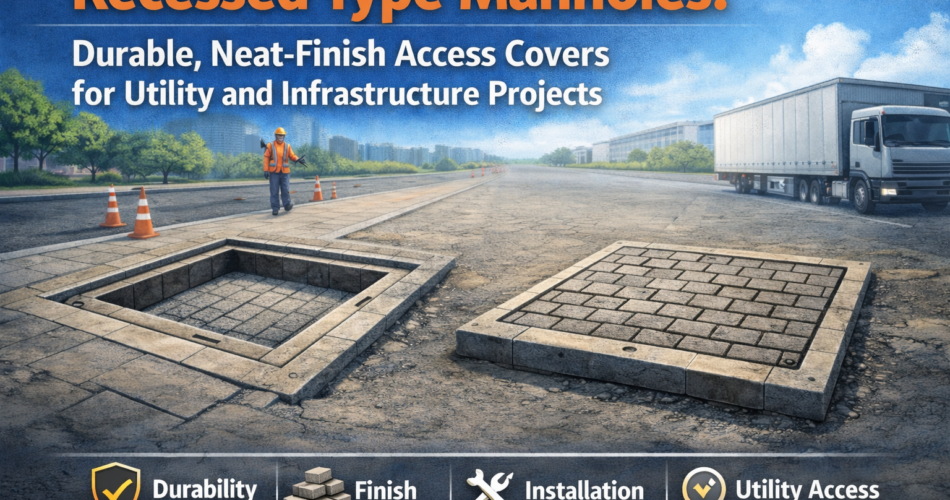
The demand for high-quality recessed type manholes continues to grow across commercial, municipal, industrial, and residential infrastructure projects. Unlike standard access covers, recessed type manholes are designed to do two things at once: provide durable access to underground systems and blend with the surrounding surface finish. That makes them a practical choice in projects where both functionality and appearance matter.
This is where buyers often get it wrong. They focus on the look of the cover and ignore the engineering quality behind it. That is a mistake. A recessed type manhole that looks neat but fits badly, shifts under use, or fails early is not a good product. It is a future maintenance problem. For real performance, buyers need a manufacturer that understands casting quality, dimensional accuracy, and long-term infrastructure use. That is where Aris Foundry becomes relevant.
What Are Recessed Type Manholes?
Recessed type manholes are access covers designed with a recessed top tray or section that can be filled with concrete, tiles, pavers, stone, or other flooring material so the top surface visually matches the surrounding area. Unlike exposed solid-top covers, recessed manholes help maintain a clean and uniform finish while still allowing access to underground utilities.
They are commonly used in:
Commercial projects
Office buildings, retail spaces, and mixed-use developments often use recessed covers to maintain a cleaner architectural appearance.
Residential developments
Premium housing projects and landscaped zones prefer recessed covers where exposed metal covers would look out of place.
Municipal and public spaces
Walkways, plazas, and external paved areas often require access systems that do not disrupt the finished surface.
Industrial and institutional campuses
In some utility and service areas, recessed type manholes are chosen where both access and surface continuity matter.
A recessed type manhole is not just a nicer-looking cover. It is still a working infrastructure component and has to perform like one.
Why Recessed Type Manholes Matter
In many projects, underground access cannot be avoided. Utility lines, drainage points, cable chambers, and service networks all need inspection and maintenance access. The problem is that standard exposed covers can interrupt the surface finish and create a rough visual result.
That is why recessed type manholes are often preferred. They help with:
Better surface integration
The finished top can match the surrounding flooring or paving.
Cleaner project appearance
They reduce the visual disruption caused by exposed access covers.
Practical underground access
They still allow maintenance teams to reach the underground system when needed.
Long-term usability
When properly manufactured, they combine appearance, strength, and functionality in one product.
The key phrase there is properly manufactured. A bad recessed cover causes more trouble than a standard one.
What Makes a Good Recessed Type Manhole?
A lot of buyers judge recessed covers the wrong way. They think appearance is the main feature. It is not. Appearance matters, but engineering matters more.
A good recessed type manhole should provide:
Structural strength
The frame and cover must handle the intended service condition without deforming or failing.
Accurate dimensions
A recessed cover needs proper depth, edge quality, and frame fit. Bad dimensional control ruins both function and finish.
Stable seating
The cover should sit securely without rocking, shifting, or creating unsafe movement.
Durable material quality
The casting material must withstand outdoor use, handling, moisture, and repeated opening and closing.
Proper finish compatibility
The recessed area should support filling with the chosen surface material without creating alignment issues.
If any of this is weak, the product is weak. It does not matter how clean it looks on day one.
Common Applications of Recessed Type Manholes
The market for recessed type manholes spans a wide range of project types because modern developments increasingly require access products that do not spoil the finished surface.
External paved areas
Used in courtyards, pathways, and paved utility access zones where surface continuity matters.
Commercial buildings
Often chosen in entry zones, service corridors, and exterior hardscape areas.
Residential projects
Used where access points need to remain practical without looking industrial or unfinished.
Institutional and civic spaces
Helpful in campuses, public-facing developments, and areas where aesthetics and access both matter.
Selected industrial and service environments
Used in places where a flush, integrated surface is preferred.
This is why recessed type manholes remain relevant across both design-driven and utility-driven projects.
Material Choice for Recessed Type Manholes
Material selection affects durability, usability, and long-term maintenance. For infrastructure and utility applications, cast iron and ductile iron are commonly used because they provide the strength and reliability needed in demanding conditions.
Cast iron recessed type manholes
Cast iron is widely used where rigidity, durability, and long service life are required.
Ductile iron recessed type manholes
Ductile iron may be preferred where improved toughness and stronger mechanical properties are needed.
The correct material depends on the project environment, expected load, usage frequency, and installation condition. A serious manufacturer should guide buyers based on real application requirements, not just price.
Why Manufacturing Quality Matters
Recessed type manholes demand better manufacturing discipline than many buyers realize. These products are not forgiving. If the frame is off, the finish will sit badly. If the cover is unstable, the surface becomes unsafe. If the recessed depth is inconsistent, the final look is compromised.
That is why buyers should care about how the product is actually made.
Aris Foundry brings relevant manufacturing strength through:
Large-scale manufacturing facility
A state-of-the-art manufacturing and machining facility spanning around 200,000 square feet.
Strong annual melting capacity
An annual melting capacity of 12,000 MT per year, supporting both regular and project-based casting requirements.
Multiple moulding lines
This helps support a variety of product sizes and casting needs.
Sand handling and testing systems
Casting consistency depends on process control, and proper sand preparation plays a major role in that.
In-house laboratory support
Chemical and physical testing capability supports better quality control.
In-house machining and fabrication
This adds practical value where buyers need more than basic raw casting supply.
These are the things that actually matter in real supplier evaluation.
Why Recessed Type Manholes Fail
Let’s be blunt. Most failures in this category come from one of four causes: cheap casting, poor dimensional control, wrong material choice, or careless buying.
Common problems include:
Loose or unstable cover fit
This creates movement, noise, and safety issues.
Incorrect recess depth
The surface finish does not align properly with the surrounding area.
Weak frame construction
The frame may distort, wear badly, or fail in service.
Poor casting finish
This affects both installation quality and long-term durability.
Inconsistent batch quality
One order looks fine, the next causes installation trouble.
These are avoidable problems if the buyer chooses a serious manufacturer instead of chasing the lowest quote.
Benefits of Choosing the Right Recessed Type Manhole
When properly designed and manufactured, recessed type manholes offer clear long-term advantages.
Better visual integration
They allow the cover to blend with surrounding finishes.
Cleaner project outcome
They support a more polished and professional final look.
Reliable utility access
They preserve access to underground systems without sacrificing usability.
Lower long-term maintenance trouble
A good product reduces fitting issues, movement problems, and premature failure.
Flexibility across applications
They work well in multiple types of projects where both appearance and access matter.
That combination is the real reason recessed covers remain in demand.
Why Experience Matters in Foundry Manufacturing
Foundry work is technical. It depends on mould quality, material behavior, dimensional control, testing, and repeat consistency. Recessed products raise the bar further because finish accuracy matters more.
Aris Foundry brings more than 35 years of industry experience. That matters because experienced foundries are generally better at:
- Product development
- Drawing interpretation
- Quality consistency
- Handling custom requirements
- Managing repeat production reliability
- Supporting infrastructure-grade manufacturing needs
For buyers, this reduces project risk. And that matters a lot more than saving a small amount upfront on a weak product.
Custom Support for Project Requirements
Not every project uses the same recessed cover size, frame depth, fill requirement, or service condition. That is why many buyers need project-specific support rather than generic supply.
Aris Foundry highlights its in-house design and engineering capability, which is useful for tailored casting solutions.
Benefits of custom support
Custom development can help buyers:
- Match products to technical drawings
- Improve installation compatibility
- Support project-specific finish requirements
- Reduce site-level modification issues
- Improve long-term fit and usability
That is the difference between dealing with a manufacturer and dealing with a supplier who only forwards quotations.
How to Choose the Right Recessed Type Manhole Supplier
If you are sourcing recessed type manholes, do not reduce the decision to appearance and price. That is shallow buying and it usually creates downstream problems.
Instead, evaluate the supplier on:
Real manufacturing capability
Do they have proper foundry infrastructure?
Quality systems
Are testing and process control built into production?
Dimensional discipline
Can they maintain accurate and repeatable frame-and-cover fit?
Material understanding
Can they recommend the right material for the intended use?
Technical support
Can they handle custom project requirements when needed?
Those are the right questions. Most buyers ignore them and then wonder why the installation goes wrong.
Conclusion
Recessed type manholes are practical access solutions for projects that need both underground utility access and a clean finished appearance. But the product only works well when it is properly manufactured. Buyers need strength, dimensional accuracy, stable fit, durable material, and reliable long-term performance.
With ISO-certified operations, a large-scale manufacturing setup, in-house testing and machining support, and decades of foundry experience, Aris Foundry is well positioned to support buyers looking for dependable recessed type manhole solutions.
The bottom line is simple. Recessed type manholes are not just aesthetic covers. They are functional infrastructure products that demand serious manufacturing quality. Source them from a foundry that can actually deliver that standard.