
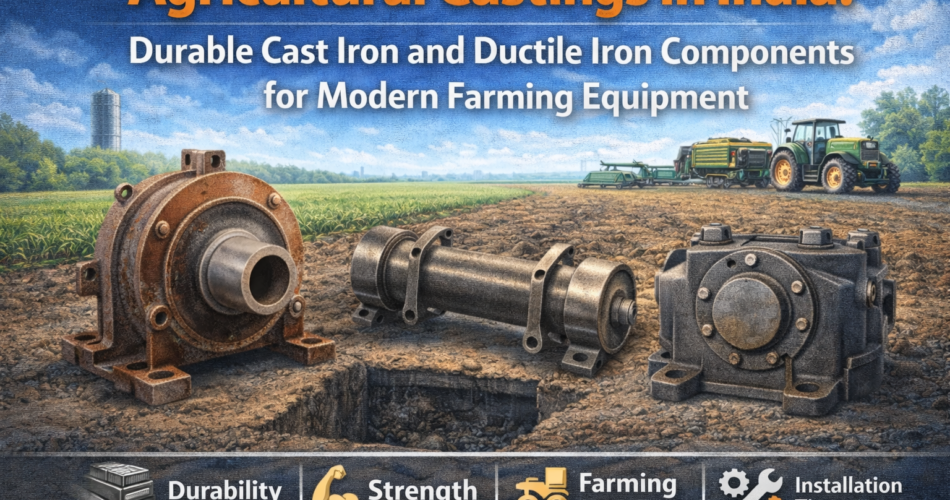
Agriculture depends on reliability. When equipment fails in the middle of field preparation, sowing, irrigation, or harvesting, the cost is not just mechanical downtime. It affects productivity, timelines, and operating efficiency. That is exactly why the demand for high-quality agricultural castings in India continues to grow. From farm machinery and tractor parts to irrigation components and heavy-duty equipment castings, the agricultural sector needs products that can perform under real working conditions, not just look acceptable in a catalog.
India’s farming environment is demanding. Agricultural machinery often operates in dust, mud, moisture, vibration, impact, and continuous field use. That means the cast components used in these systems must be strong, durable, dimensionally reliable, and suited for long-term service. Weak or inconsistent castings create breakdowns, maintenance issues, and unnecessary replacement cost.
For an experienced manufacturer like Aris Foundry, agricultural castings are a natural fit within a broader portfolio of cast iron and ductile iron products used in infrastructure, industrial, utility, and engineering applications. With ISO 9001:2015 certified operations, decades of foundry expertise, modern production infrastructure, and strong quality control systems, the company is well positioned to support agricultural casting requirements in India with a focus on performance and dependability.
What Are Agricultural Castings?
Agricultural castings are metal cast components used in farming equipment, agricultural machinery, and allied mechanical systems. These parts are typically manufactured in cast iron or ductile iron, depending on the required strength, toughness, and application environment.
They are used in a wide variety of farm-related products and equipment where durability and structural performance matter. These castings may form part of machinery bodies, housings, covers, support structures, implements, moving assemblies, and other mechanical components required for agricultural operation.
In practical terms, agricultural castings are important because farming equipment must operate under hard use conditions. These are not decorative or low-stress parts. They are functional engineering components that need to withstand force, wear, load, and outdoor exposure over time.
Why Agricultural Castings in India Matter
India has one of the world’s largest agricultural sectors, and that scale creates a constant need for durable machinery and dependable equipment components. Whether the equipment is used in small-scale operations or larger mechanized farming environments, the need remains the same: components must work consistently in the field.
Agricultural castings in India matter because they help support:
Durability in Tough Field Conditions
Farm equipment is exposed to rough terrain, repeated use, weather changes, moisture, soil contact, and operational stress. Cast components need to survive this without failing prematurely.
Reliable Equipment Performance
Machine performance depends heavily on the quality of its parts. Good castings support stability, strength, and smoother operation.
Lower Maintenance Burden
Poor-quality castings lead to breakdowns, replacements, and downtime. Better castings reduce these issues and help keep equipment in service longer.
Support for Agricultural Mechanization
As agricultural systems become more mechanized, the need for well-manufactured engineering components becomes even more important.
Long-Term Cost Efficiency
Cheap castings often become expensive later through repair, rejection, and repeated part replacement. Durable components provide better lifecycle value.
Common Applications of Agricultural Castings
Agricultural casting requirements vary depending on the equipment type and intended use. The range is broad, and that is exactly why foundry capability matters. A serious manufacturer must be able to support different shapes, weights, and application demands.
Agricultural Castings in India for Farm Equipment and Machinery
Tractor and Equipment Components
Agricultural machines often require cast housings, brackets, covers, counterweights, support parts, and structural components that can handle load and vibration.
Irrigation and Water Management Systems
Selected cast components are used in agricultural water handling and irrigation-related systems where durability and outdoor performance are essential.
Implements and Field Machinery
Plough-related assemblies, tillage equipment, sowing systems, harvesting components, and other farm implements may require robust cast parts designed for repetitive ground-contact or heavy-duty use.
Gear and Motor-Related Castings
In mechanically driven agricultural equipment, cast components may be used in gear housings, motor bodies, and machine support structures.
Custom Agricultural Equipment
Many agricultural machinery manufacturers and fabricators require customized castings designed for specific equipment types, sizes, and operating conditions.
Why Material Selection Is Critical
This is where many buyers make a bad decision. They focus too much on price and too little on application suitability. That is the wrong approach. In agricultural equipment, the casting material directly affects durability, wear resistance, impact handling, and service life.
Cast Iron Agricultural Castings
Cast iron is widely used in agricultural applications because of its durability, compressive strength, castability, and cost-effectiveness. It is suitable for a broad range of equipment components where solid structural performance is required.
Ductile Iron Agricultural Castings
Ductile iron offers higher strength, improved toughness, and better resistance to impact compared to conventional grey iron in many applications. It is especially useful where the component is subjected to more demanding service conditions or dynamic mechanical stress.
The correct choice depends on the actual function of the part. A supplier that treats every casting the same is not doing engineering. They are just selling metal.
What Buyers Should Look for in Agricultural Castings
If you are sourcing agricultural castings in India, do not evaluate suppliers on quotation value alone. That is lazy procurement, and it usually causes expensive problems later.
The right questions are about material quality, consistency, performance, and manufacturing capability.
Agricultural Castings in India: Key Factors That Matter
Casting Quality
The part should be structurally sound and manufactured with proper process control. Defects, weak sections, and inconsistency create performance problems in the field.
Dimensional Accuracy
Many agricultural components need correct fitting within equipment assemblies. Poor dimensions lead to installation trouble, misalignment, and added machining or rejection.
Material Integrity
The iron grade and metallurgical control must suit the intended application. Not every agricultural part needs the same material performance.
Wear and Impact Resistance
Field equipment often operates under abrasive and high-use conditions. The casting should be capable of handling practical wear and handling stress.
Machining and Finishing Support
Some parts require machining, drilling, shaping, or specific finishing before use. A capable foundry should be able to support these requirements.
Customization Capability
Agricultural equipment manufacturers often need custom-designed cast parts rather than generic off-the-shelf products. Flexibility matters.
Production Consistency
A single good sample is not enough. Buyers need repeatable quality across batches, especially for OEM and large-order requirements.
Why Foundry Capability Matters More Than Sales Claims
A lot of suppliers can promise quality. Far fewer can produce it consistently.
Agricultural castings require control over pattern making, moulding, sand systems, metal quality, testing, machining, and finishing. Without that manufacturing discipline, the result is inconsistency. And in equipment supply, inconsistency becomes rejection, downtime, and warranty trouble.
Aris Foundry offers manufacturing strengths that are directly relevant here:
More Than 35 Years of Foundry Experience
Experience matters in casting because quality comes from process knowledge, not guesswork.
ISO 9001:2015 Certified Operations
A structured quality system supports better production control and repeatability.
Modern Manufacturing Infrastructure
With a large-scale foundry and machining facility, multiple moulding lines, sand handling systems, and in-house fabrication support, the company has the process depth needed for demanding casting applications.
In-House Testing Facilities
Chemical and physical testing capability helps improve material control and product reliability.
Engineering and Product Development Support
Agricultural equipment often requires application-specific solutions. In-house technical support makes a real difference when customization is needed.
Domestic and Global Quality Orientation
A manufacturing approach aligned with recognised standards and export expectations generally reflects stronger seriousness in product quality.
The Cost of Choosing Poor-Quality Agricultural Castings
A cheaper part is not cheaper if it fails in use. That is the reality many buyers learn too late.
Low-grade agricultural castings can lead to:
- premature part failure
- equipment downtime
- repeated replacement
- assembly issues
- customer complaints
- higher maintenance cost
- inconsistent product performance
For machinery manufacturers, dealers, and end users, those problems damage both cost efficiency and trust. A better casting may cost more upfront, but it usually saves money across the full operating cycle.
Why Aris Foundry Is Relevant for Agricultural Casting Requirements
Aris Foundry’s manufacturing profile matches the needs of buyers looking for agricultural castings in India that are built for real use. The company manufactures grey iron and ductile iron castings with a focus on strength, reliability, and standards-oriented production. Its experience across industrial, utility, infrastructure, and engineering casting applications adds value for agricultural component requirements where durability matters.
With strong production capability, testing support, machining infrastructure, and a practical understanding of performance-driven casting supply, the company is well suited for customers seeking dependable agricultural castings rather than low-grade commodity output.
Conclusion
The demand for agricultural castings in India will continue to rise as farming equipment becomes more mechanized, performance expectations increase, and buyers place greater value on long-term durability. These castings play a direct role in machinery strength, operating reliability, and maintenance efficiency. That makes quality non-negotiable.
Agricultural components work in harsh environments. They need sound material, proper casting control, and a manufacturer that understands the difference between a price-led product and a performance-led one. Weak castings create operational problems. Strong castings support better equipment and better field results.
For businesses looking for durable cast iron and ductile iron components for agricultural machinery and equipment, Aris Foundry offers the experience, manufacturing strength, and quality-focused approach required for dependable agricultural casting solutions in India.