
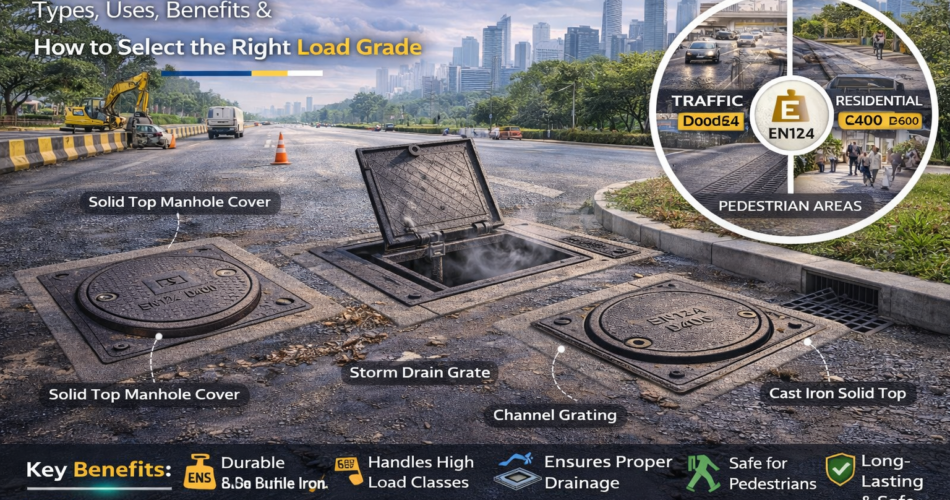
Municipal and drainage castings are essential infrastructure products used in city roads, public utilities, stormwater networks, sewer lines, and civic projects. These castings—typically made from grey cast iron or ductile iron (SG iron)—cover underground chambers safely, allow access for maintenance, and enable efficient surface water drainage.
If municipal castings fail, the impact is immediate: broken covers, road hazards, flooding, public complaints, and costly emergency replacements. That’s why the right design, material, and load suitability matter more than “lowest price.”
What Are Municipal and Drainage Castings?
Municipal and drainage castings are cast components used in public infrastructure for:
- covering access chambers (manholes, valve chambers)
- collecting and channeling rainwater runoff
- protecting underground utilities (water, sewer, telecom, power)
- ensuring safe traffic movement over utility access points
They are designed for continuous outdoor exposure and repeated loading by pedestrians and vehicles.
Common Types of Municipal and Drainage Castings
Depending on project requirements, municipal and drainage castings include:
- Manhole covers and frames (solid top, recessed type, heavy-duty carriageway)
- Catch basin gratings and frames
- Gully gratings and roadside drain gratings
- Surface boxes and valve boxes
- Cleanouts and access lids
- Trench/channel gratings (as per drainage design)
- Custom municipal castings for special utility chambers and layouts
These products are selected based on drainage flow needs, chamber size, and load conditions at the installation site.
Where Municipal and Drainage Castings Are Used
They are widely installed in:
- City roads and highways
- Footpaths and public walkways
- Parking lots and commercial complexes
- Residential townships and campuses
- Industrial parks and logistics yards
- Stormwater and sewer networks
- Utility corridors for water supply, telecom, and power
In short: anywhere a city needs safe access and effective drainage, these castings are involved.
Key Benefits of Municipal and Drainage Castings
High-quality municipal castings deliver:
- Public safety: Strong covers and anti-slip surfaces reduce accidents.
- Efficient drainage: Proper grating design helps prevent waterlogging.
- Debris control: Catch basin and gully systems reduce drain choking.
- Long service life: Controlled metallurgy and good design resist wear and corrosion.
- Lower maintenance cost: Less breakage and fewer road cuts over time.
- Better ride quality: Proper seating reduces rocking and traffic noise.
Grey Cast Iron vs Ductile Iron (SG Iron): What’s Better?
Both are used in municipal projects, but the choice depends on load and performance expectations.
Grey Cast Iron
- Cost-effective for standard municipal usage
- Suitable where impact loads are moderate
- Common for many drainage and utility applications
Ductile Iron (SG Iron)
- Higher tensile strength and impact resistance
- Better for heavy traffic, carriageways, and industrial movement zones
- Lower risk of cracking under repeated shock loads
For high-load and high-risk areas, ductile iron is usually the more reliable long-term option.
How to Select Municipal and Drainage Castings (Checklist)
Don’t select based on size and price only—verify these essentials:
- Load suitability: Footpath, roadway, or heavy vehicle zone—choose accordingly.
- Correct seating and stability: Prevents rocking, rattling, and early failures.
- Anti-slip surface design: Important for wet and high-footfall areas.
- Drainage capacity and slot design: Must handle rainfall without clogging.
- Corrosion protection: Epoxy or protective coating improves durability.
- Dimensional consistency: Ensures smooth installation and long-term fit.
- Testing and compliance: Products should be manufactured and tested as per relevant project requirements.
If you skip load suitability, everything else becomes irrelevant.
Common Failures in Municipal Castings (And Their Root Cause)
- Cracked covers/gratings: Wrong load rating or poor quality casting
- Noise and movement: Poor machining/fitment and weak bedding
- Frequent drain choking: Incorrect slot design or no silt-trap chamber
- Rusting and seizure: Poor coating and material control
These failures are predictable—and preventable—when specification and procurement are done correctly.
Conclusion
Municipal and drainage castings are not “small accessories”—they are safety-critical and performance-critical infrastructure components. Choosing the right product type, correct material, and proper load grade improves public safety, drainage efficiency, and long-term cost control.
For reliable civic and drainage infrastructure, specify municipal castings based on real site load conditions, consistent quality, and proven manufacturing capability—because replacing failed castings after road completion is always expensive and disruptive.